
Architecture & Design Pillars
Kite is built from first principles for autonomous agents, not adapted from human-centric systems. Every architectural decision optimizes for one goal: enabling agents to operate with mathematical safety guarantees.
Architecture Overview
Four-Layer Architecture
Kite implements a four-layer architecture that separates concerns while maintaining security and performance:
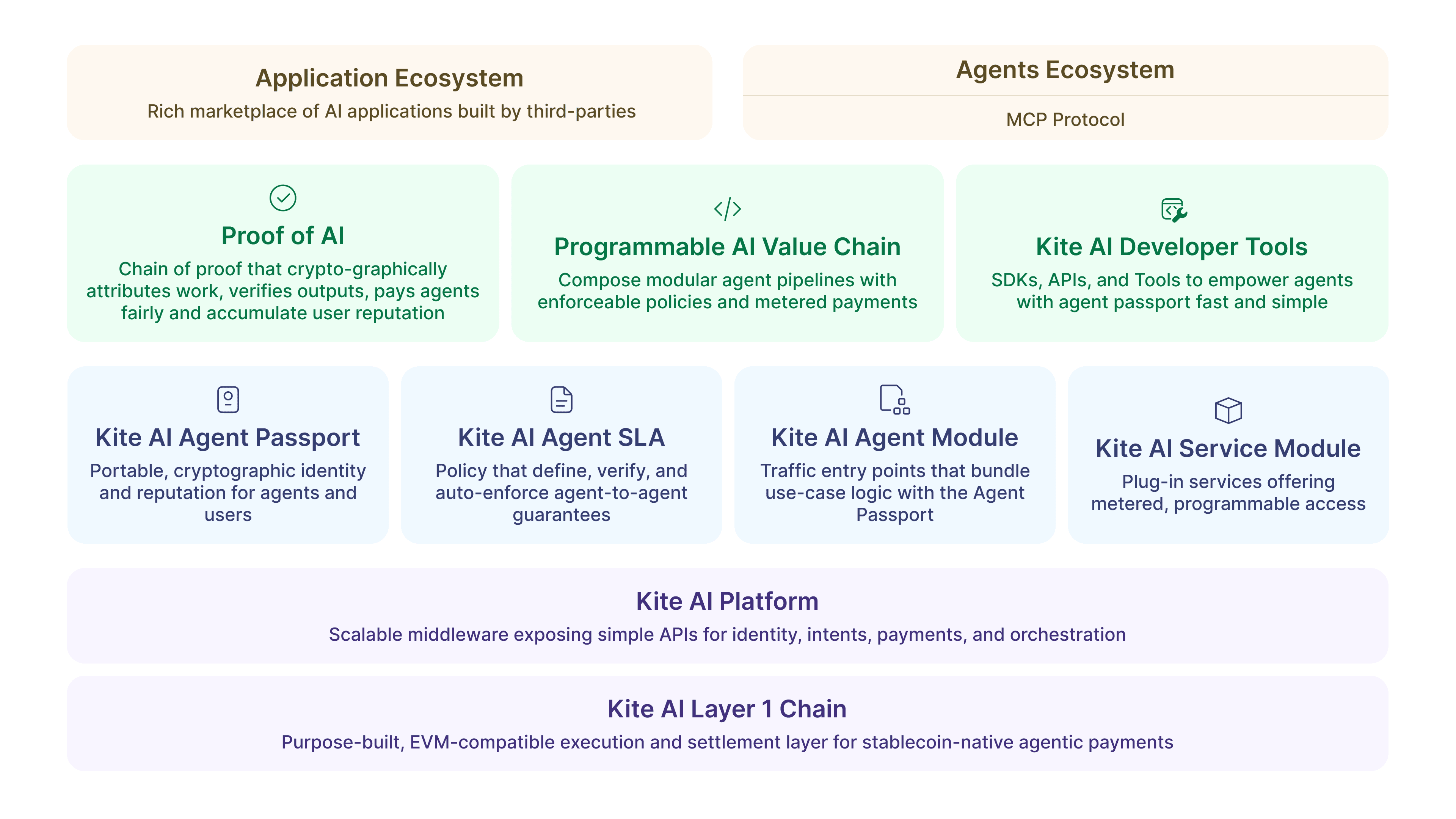
Base Layer: EVM-Compatible L1
Optimized specifically for agent transaction patterns:
- Stablecoin-native fees: Predictable costs in USDC/pyUSD, eliminating gas token volatility
- State channels for micropayments: $0.000001 per message with instant settlement
- Dedicated payment lanes: Isolated blockspace preventing congestion
- Agent transaction types: Not just payments, but computation requests and API calls embedded in transactions
Platform Layer: Agent-Ready APIs
Abstracts blockchain complexity for developers:
- Identity management: Hierarchical wallets with BIP-32 derivation
- Authorization APIs: Session key generation and management
- Payment processing: State channel opening, signing, and settlement
- SLA enforcement: Automatic penalty and reward execution
Programmable Trust Layer
Novel primitives that enable trustless agent operations:
- Kite Passport: Cryptographic agent IDs with selective disclosure
- x402 Protocol: Standardized rail for agent-to-agent intents, enabling verifiable message passing, escrowed execution, and settlement across ecosystems
- Agent SLAs: Smart contract interaction templates with enforced guarantees
- Protocol bridges: Compatibility with A2A, MCP, OAuth 2.1, and AP2
- Reputation system: Verifiable behavioral history portable across services
Ecosystem Layer
Two interconnected marketplaces:
- Application marketplace: AI services registered once, discoverable by millions of agents
- Agent ecosystem: Agents coordinate through standard protocols
- Service discovery: Cryptographic capability attestations enable trustless matching
- Reputation networks: Global trust scores based on verifiable performance
For detailed architectural components and terminology, see Core Concepts & Terminology
Design Principles
1. Agent-First Architecture
Traditional blockchains assume human users who can manage keys and evaluate risks. Kite breaks this assumption entirely:
- Hierarchical Identity: User → Agent → Session with cryptographic delegation
- Programmable Constraints: Smart contracts enforce spending limits and operational boundaries that agents cannot exceed
- Session-Based Security: Ephemeral keys for individual operations, not permanent credentials
- Agent Transaction Types: Embedded API requests within payments, not just value transfers
2. Cryptographic Trust Chain
Every action creates verifiable audit trails:
- No Direct Key Access: Agents never touch private keys directly
- Fine-Grained Authorization: Task-level permissions, not agent-level
- Reputation Without Identity Leakage: Shared reputation with independent identity
3. Sovereignty Through Separation
- Decentralized Assets: Self-custodial wallets with smart contract enforcement
- Centralized Services: Platform APIs for developer experience
- Best of Both: Security of decentralization + usability of centralization
4. Native Protocol Compatibility
Rather than creating another isolated protocol, Kite embraces existing standards as first principles:
- A2A Protocol: Direct agent coordination across platforms
- Agent Payment Protocol (AP2): Kite executes AP2 intents with on-chain enforcement
- MCP: Model interoperability across the entire LLM ecosystem
- OAuth 2.1: Backward compatibility with existing services
- X402 Standard: Agent-native payments for future developments
5. Mathematical Safety Guarantees
- Provable Bounds: Users know exact maximum exposure before authorizing agents
- Cryptographic Enforcement: Constraints cannot be violated even with total agent compromise
- Automatic Expiration: All authorizations include time-based revocation
- Defense in Depth: Multiple security layers with graduated impact
6. Economic Viability for Micropayments
- Sub-cent Transactions: Enable per-message, per-token, per-request pricing
- Predictable Costs: Stablecoin fees eliminate gas token volatility
- Instant Settlement: Real-time value transfer without waiting periods
- Global Interoperability: Borderless payments without currency conversion
For detailed concepts and terminology, see Core Concepts & Terminology